
Keyword cannibalization and AI Overviews: how one fix took a page from #63 to #1
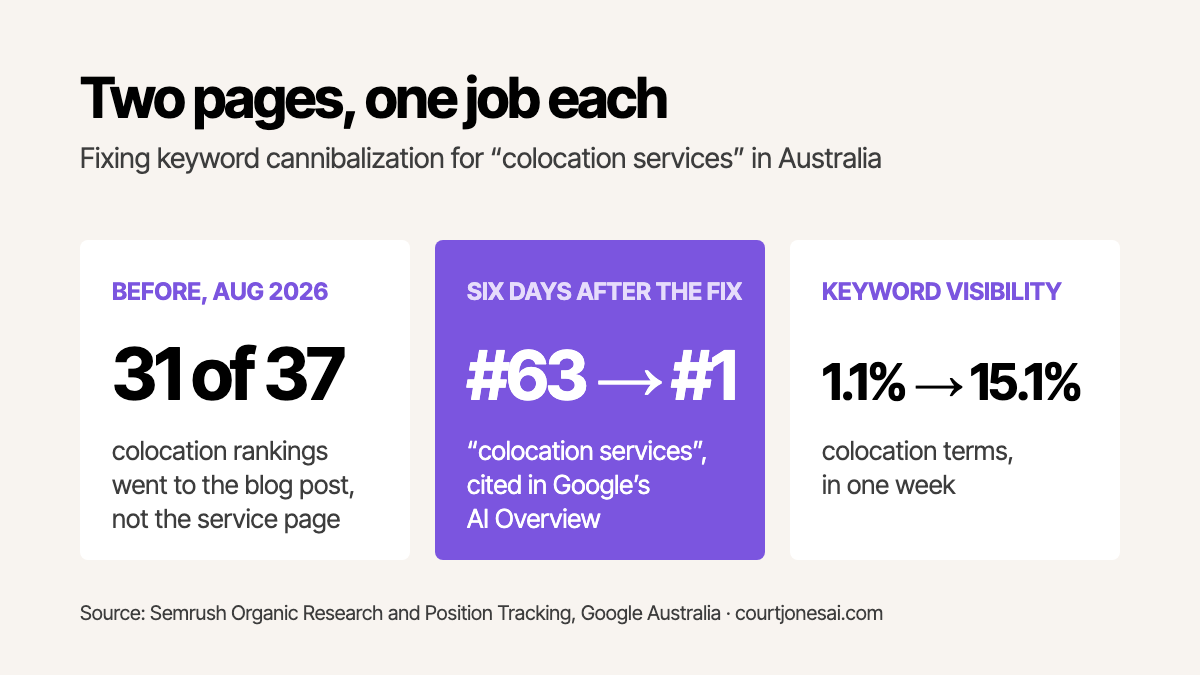
Keyword cannibalization happens when two of your pages compete for the same search, so neither wins. For a Canadian cloud provider in Australia, a colocation service page and a colocation blog post split 37 rankings. After I gave each page one job, “colocation services” went from #63 to #1 in six days, with an AI Overview citation.
Key takeaways
- Two overlapping pages left both stuck off page 1 for five shared searches.
- I kept both pages, because the blog had 20 referring domains.
- Each page got one job: one sells colocation, one explains it.
- Google chose the rewritten explainer for “colocation services”, not the service page.
- The fix took one week to show. Some head terms still need winning back.
What is keyword cannibalization, and why does it matter for AI Overviews?
Keyword cannibalization is when several pages on one site target the same search. Google has to guess which page to rank, and often ranks neither well. It matters more now, because AI Overviews draw on pages that already rank. If neither page ranks well, neither is likely to be cited.
Why overlap hurts AI answers too
Google says its AI features draw on pages in its index and link to supporting sources (Google Search Central). So the ranking problem becomes a citation problem.
My working view is simple. One clear page is easier to quote than two half-answers. For the basics behind that, read how GEO, AEO and SEO fit together.
How did I find the keyword cannibalization?
I found it while planning a rebuild of the client’s Australian site in September 2026. In August, 31 of 37 colocation rankings went to the blog post and only 6 to the service page. On five searches, both pages ranked at once. Neither reached page 1, and none of those searches drove traffic.
| Search (Australia) | Searches a month | Service page | Blog post |
|---|---|---|---|
| colocation data centre australia | 70 | #33 | #84 |
| secure colocation | 70 | #23 | #78 |
| australia colocation | 50 | #60 | #18 |
| colocation canberra | 110 | #68 | #29 |
| colocation solution | 70 | #71 | #31 |
Source: Semrush Organic Research, Australia database, August 2026.
Why I didn’t redirect the blog post
The usual fix is to merge the pages and redirect one. Google describes redirects and canonicals as ways to consolidate duplicates (Google Search Central).
Here, the blog beat the service page on 3 of 4 shared terms. It also had 20 referring domains. Deleting it would have thrown that away, so I kept both pages.
What did I change?
I gave each URL one job and rewrote both on the same day, September 30, 2026. The service page now owns commercial searches from buyers ready to talk. The blog post now explains colocation for buyers still learning. Then I linked the explainer down to the service page and tracked every colocation term daily.
One job per URL
The service page targets buyers comparing providers. The blog post targets questions like “what is colocation?” Neither page tries to do both jobs anymore.
A question-led explainer
I rewrote the blog post as a question-led explainer. It answers three buyer questions. What is colocation? What does it cost? How does colocation compare with cloud?
Question-led pages are easy for readers and AI tools to scan. They also make the page’s job obvious.
Links that point the right way
The explainer links down to the service page for readers ready to buy. I’m also pointing internal links and anchor text for commercial phrases at the service page.
What happened after the fix?
“Colocation services” (210 searches a month) went from #63 to #1 on Google Australia between September 29 and October 5, 2026. Google’s AI Overview cited the rewritten page. Colocation keyword visibility rose from 1.1% to 15.1% in the same week. Not every term moved, and the results cover one week.
Google picked the explainer, not the service page
This surprised me. On September 29, the service page held #63 for “colocation services”. After the rewrite, Google switched to the explainer and ranked it #1.
The lesson is useful. You can assign jobs, but Google decides intent. Track which URL ranks, not just the position.
What didn’t move
- “colocation” (720/mo) and “colocation data centre” (260/mo) fell out of the top 100 on September 23. That was a week before the rewrite.
- “colocation service provider” dropped from #21 to #43. Both URLs still compete for it.
- The service page still needs pricing signals, facility detail and a comparison table to win commercial searches.
The full data and charts are in the colocation case study.
How can you fix keyword cannibalization on your site?
Start by listing every search where two of your URLs rank at once. Then decide each page’s job from its strengths, not its URL. Merge pages only when one has nothing worth keeping. Otherwise, rewrite each page for one intent, link them together, and track which URL ranks every day.
- Find the overlap. In Semrush or Google Search Console, list queries where two of your URLs rank.
- Check what each page has. Compare rankings, referring domains and traffic before cutting anything.
- Assign one job each. Usually one page explains and one page sells.
- Rewrite and link. Answer each page’s questions directly, then link explainer to seller.
- Track the URL, not just the rank. Google may pick a different page than you planned.
The same “one page, one job” idea drove a bigger result in Canada. Read how a cloud provider became the most-cited source for sovereign cloud. To find overlap on your own site, start with an AI visibility audit.
Glossary
| Term | Meaning |
|---|---|
| Keyword cannibalization | Two or more of your pages competing for the same search. |
| Search intent | What the searcher wants: to learn, compare or buy. |
| Google AI Overview | The AI-written summary at the top of some Google results, with source links. |
| Referring domains | Other websites that link to a page. |
| Redirect | Sending visitors and search engines from one URL to another. |
| Canonical tag | A tag telling search engines which of several similar URLs is the main one. |
Sources
- Client data: Semrush Organic Research and Position Tracking, Google Australia, August to October 2026. The client isn’t named.
- Google Search Central, “AI features and your website.” Read the guidance
- Google Search Central, “How to specify a canonical with rel=canonical and other methods.” Read the guidance
What else do people ask about keyword cannibalization?
Does keyword cannibalization affect AI Overviews?
It can. AI Overviews draw on pages that already rank. If two of your pages split a search and neither ranks well, neither is likely to be cited.
Should I redirect one of the competing pages?
Only if one page has nothing worth keeping. Here, the blog had 20 referring domains, so I gave each page a different job instead.
How long does a cannibalization fix take to show?
This one showed in six days: #63 to #1 between September 29 and October 5, 2026. Some head terms still hadn't recovered a week later.
How do I find keyword cannibalization?
List searches where two of your URLs rank at the same time. Semrush and Google Search Console both show which URL ranks for each query.