
How a Canadian cloud provider became the most-cited source for sovereign cloud in AI answers
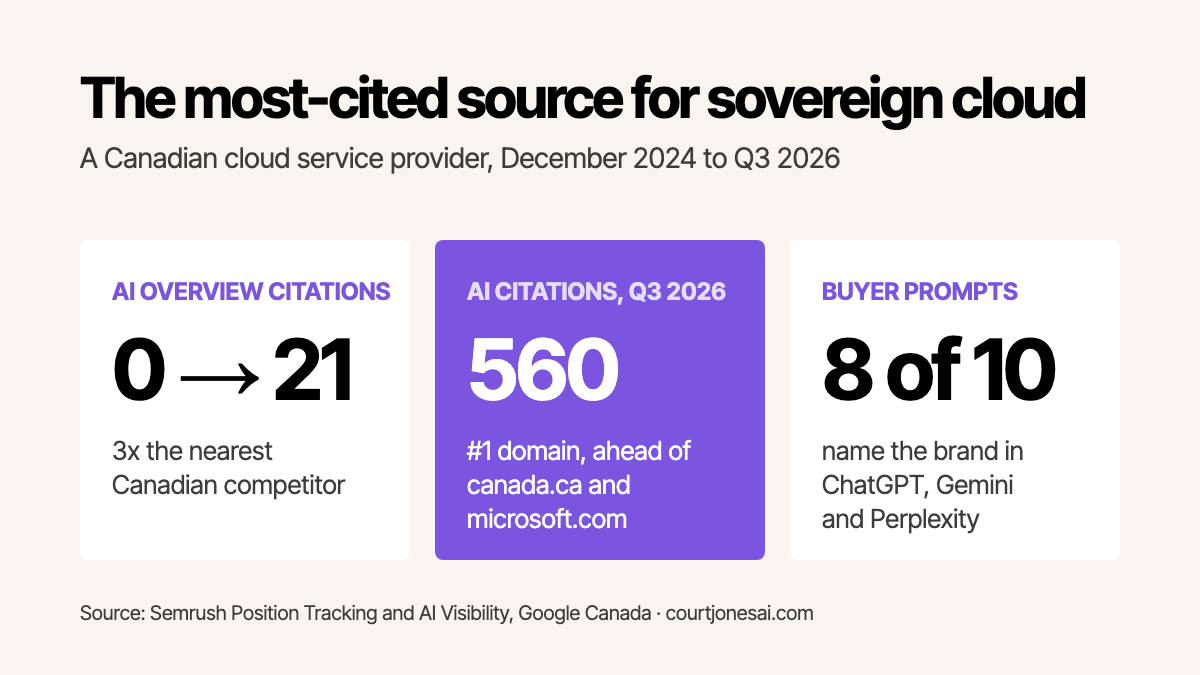
A Canadian cloud service provider became the most-cited domain for sovereign cloud in AI answers. It got there with two pages built around buyer questions. In Q3 2026 it earned 560 AI citations, ahead of canada.ca and microsoft.com. I led that work in-house from December 2024. Here is the timeline, the method and the setbacks.
Key takeaways
- The client went from 0 to 21 Google AI Overview citations in Canada.
- Two pages did most of the work: a sovereign cloud pillar and one data residency guide.
- The sovereign cloud page alone earned 287 AI citations, the most of any tracked URL.
- A competitor overtook us in mid-2026. A September refresh won the citations back.
- We measured citations against named competitors, not just keyword rankings.
Where did the client start?
In December 2024 the client had zero Google AI Overview citations for its Canadian keywords. Its search visibility across 185 tracked Canadian keywords was 1.6%. Competitors held almost all of the sovereignty searches we cared about. That was the baseline I measured everything against for the next two years.
Who was the competition?
OVHcloud was the main rival on sovereignty searches. By March 2026 it led on the same terms, with 9.96% visibility to our 6.94%.
By July 2026 OVHcloud was cited in 19 AI Overviews. We were cited in 11, and AI assistants still rarely named the brand. Progress was real, but we were second.
What did we change to earn AI citations?
We gave AI two clear sources to quote. The sovereign cloud page became the pillar for Canadian data sovereignty searches. One guide covered data residency, data sovereignty and the US CLOUD Act together. Then we tracked every citation against Canadian competitors and refreshed both pages when our lead slipped.
One pillar page for one buyer need
I made the sovereign cloud page the home for every Canadian data sovereignty search. I structured it around the questions buyers ask AI tools.
That focus matters. When two pages compete for one question, neither wins. I saw the same pattern in a colocation cannibalization fix in Australia.
One guide for three tangled topics
Buyers often mix up data residency, data sovereignty and the US CLOUD Act. So we published one guide that answered all three, on June 18, 2026.
That guide later ranked #1 in Canada for “data residency”, “data sovereignty canada” and “cloud act canada”. All three also appeared inside Google’s AI-written answer.
Tracking citations, not only rankings
Rankings alone hid the real story. So I tracked AI Overview citations and AI prompt mentions in Semrush, against named Canadian competitors.
I also tracked all 185 Canadian keywords daily. That made a drop visible within days, not at month end.
A refresh when the lead slipped
OVHcloud’s lead in July told us the work wasn’t finished. In late September 2026 we refreshed both pages.
Within 30 days, visibility rose from 6.1% to 13.7%. That was 3.4 times OVHcloud’s visibility on the same keywords.
What were the results?
By September 30, 2026, the client was cited in 21 Google AI Overviews. That was three times its nearest Canadian competitor. Its domain was the most-cited source for sovereign cloud, with 560 AI citations. Eight of 10 tracked buyer prompts named the brand in ChatGPT, Gemini and Perplexity.
| Measure | December 2024 | Q3 2026 |
|---|---|---|
| Google AI Overview citations, Canada | 0 | 21 (Sep 30), vs 7 for the nearest competitor |
| Search visibility, 185 Canadian keywords | 1.6% | 13.7% (Oct 1), 3.4x OVHcloud |
| AI citations to the domain, sovereign cloud | Not tracked | 560, the #1 most-cited domain |
| AI citations to the sovereign cloud page | Not tracked | 287, the #1 most-cited URL |
| Buyer prompts that name the brand | Not tracked | 8 of 10 |
| AI share of voice vs direct Canadian competitors | Not tracked | 22–25%, 4–5x the quarterly target |
| #1 Google rankings inside the AI Overview | None | 14 sovereignty terms |
Sources: Semrush Position Tracking and AI Visibility, Google Canada, and the client’s Q3 2026 AI visibility report. The full data is in the AI Overview citations case study and the data sovereignty search case study.
Which buyer prompts named the client?
On October 3, 2026, these prompts named the client across ChatGPT, AI Overviews, AI Mode and Gemini:
- “canadian cloud providers”
- “cloud providers in canada”
- “canadian cloud storage”
- “How do Canadian providers handle offsite backups and data residency for servers?”
- “What are the best cloud backup solutions for MSPs and small businesses?”
Did AI citations bring visitors?
Yes, but modestly. The sovereign cloud page became the top landing page for visitors from AI assistants. Weekly AI-referred sessions rose from 15 to 128 in January 2026.
That peak did not last. I cover the numbers in the AI-referred traffic case study.
What would I repeat for another B2B tech brand?
I would repeat four things. Answer the exact question buyers type into AI. Give each page one clear job. Measure citations against named competitors, not just rankings. And plan refreshes, because a citation lead can disappear within a quarter. None of this guarantees placement, but each step made the brand easier to cite.
Answer the question the buyer types
Buyers rarely type your product name. They ask what data residency means, or which providers keep data in Canada. Build pages that answer those questions first.
Give each page one clear job
One page per buyer need makes it obvious which URL to cite. Adding sources, quotes and statistics helps too. Peer-reviewed research found it raised visibility in AI answers by up to 40% (Aggarwal et al., 2023).
Measure AI citations against named competitors
A ranking report would have shown progress in July. The citation count showed OVHcloud ahead. Track both, against the same competitors, every week. That is what AI share of voice monitoring does.
Plan the refresh before you need it
Our lead slipped within months, and a refresh won it back. Schedule reviews for your best-cited pages, and act fast when citations drop.
Google says its AI features draw on pages in its index and link to supporting sources (Google Search Central). So classic SEO still decides who gets cited. For the basics, read what AI visibility is and how GEO, AEO and SEO differ.
Glossary
| Term | Meaning |
|---|---|
| AI citation | A link to your page shown as a source behind an AI answer. |
| Google AI Overview | The AI-written summary at the top of some Google results, with source links. |
| AI share of voice | The share of tracked AI answers that mention you, compared with competitors. |
| Data residency | Where your data is physically stored, such as in Canadian data centres. |
| Data sovereignty | Whose laws apply to your data, based on where it lives and who controls it. |
| US CLOUD Act | A US law that can require US companies to hand over data, even if it is stored abroad. |
| Pillar page | The main page for a topic, which related pages link to. |
Want to know where your brand stands? An AI visibility audit tests your buyer prompts against your competitors. Or compare all AI SEO services and pricing.
Sources
- Client data: Semrush Position Tracking and AI Visibility (Google Canada, 2024–2026) and Google Analytics 4. The client isn’t named.
- Aggarwal et al., “GEO: Generative Engine Optimization,” Princeton University and others, 2023; published at KDD 2024. Read the paper
- Google Search Central, “AI features and your website.” Read the guidance
What else do people ask about earning AI citations?
How long did it take to become the most-cited source?
About 21 months. Work started in December 2024, and the client led sovereign cloud citations in Q3 2026. The biggest jump came in the 30 days after a September 2026 refresh.
Which AI tools cited the client?
Google AI Overviews and AI Mode cited its pages. ChatGPT, Gemini and Perplexity named the brand in 8 of 10 tracked buyer prompts.
Can a smaller cloud provider do the same?
Yes, on specific questions. Narrow topics like Canadian data residency have fewer strong sources, so a focused page with clear answers can earn citations.
How do you measure AI citations?
Track a fixed set of buyer prompts and keywords against named competitors. Record which URLs AI cites, and repeat on a schedule, not just once.